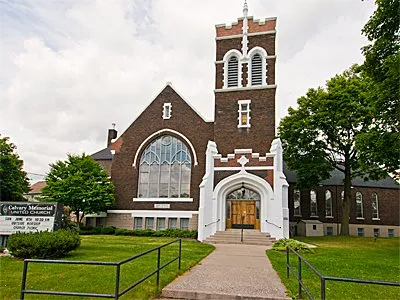
100 Years Remembered!
1922 - 2022
Happy 100th Birthday, Calvary! Since the pandemic has lessened and we can now finally return to this beautiful sanctuary, I hope each of us will pause for a moment to appreciate the fact that this sacred space with its beautiful stained glass windows, is 100 years old and largely unchanged from the sanctuary that folks entered for the first time in 1922. They came, and others followed, to worship and to learn, to feel inspired or comforted or loved or challenged or simply accepted as part of a spiritual community in their own neighbourhood.
The building was a gift from people in another spiritual community, the Zion Evangelical Church on Weber Street, who believed as their ancestors had, that God’s message was intended to be spread to others. With amazing generosity they fulfilled the dream of establishing a place for a Sunday School and special worship in Kitchener’s growing north end.
During this Centennial year, the Anniversary Committee would like to share with you, bit by bit, a few highlights of past events that you may or may not know about, as well as occasional bits of trivia that may surprise you.
In The Beginning
1800 - 1922
Let’s begin at the beginning. Did you know that . . .
Calvary's roots are found in the Evangelical Association, a denomination "made in America" by German settlers who wanted to worship in their own language. It was one of the earliest denominations established in America that was entirely independent from any established religion in the homelands they had left behind.
Many of these settlers had been connected to Methodism before they immigrated, and because of that influence they maintained a strong belief that their mission was to spread the Gospel. With this command in their hearts they sent missionaries and preachers to German-speaking parts of America, and north to Canada, especially to Berlin and the surrounding area.
The first Evangelical camp meeting in Canada was organized in1839 and held in a clearing between the villages of Waterloo and Bridgeport. It attracted a large crowd reported to be between 600 to 800 German-speaking folks who, like the earlier American settlers, wanted to hear God’s message in their first language. Evangelical Bishop Jacob Seybert was invited to lead this revival meeting by someone who pleaded that he was needed because they were “like sheep without a shepherd”. He rode 400 difficult miles on horseback from Chicago to speak to the crowds. He and 5 other missionaries as well as local preachers led sessions morning, noon and night.This camp meeting had the effect of stirring spiritual longings in many and resulted in a congregation being formed in Berlin the same year, 1839.
Did you know that a plaque in Hillside Park (near Lexington Road and the Expressway) commemorates the site of this first camp meeting. Finding the plaque now is a bit of a challenge! Ask Marney! who found it one day and took pictures to prove it.
The Zion congregation soon grew to be the largest Evangelical Church in the Canadian Conference and as a result, Zion became known as the “Mother Church” to other Evangelical churches in Canada including Emmanuel Waterloo and Emmanuel Bridgeport. Through the next decades the Evangelical Church grew and spread to many small towns in southern Ontario, and to other locations in Manitoba and the Ottawa Valley. Many of you will have grown up in one of these congregations and we would love to hear your stories.
It was in 1898 that the Reverend JP Hauch made a proposal at a Quarterly Conference meeting that Zion Evangelical Church should begin looking for a building in which to establish a Sunday School and a place for preaching in the growing North Ward of Berlin.
Although the idea was never entirely forgotten, neither was it acted upon for another 20 years until a committee at Zion was appointed to look seriously for a site for a second Evangelical Church. As Berlin, which was renamed Kitchener in 1916, began to expand toward the north, and Waterloo expanded to the south, it was clear that property close to King Street was becoming a desirable location for new buildings and facilities. The area developed quite rapidly in the early decades of the 20th century. A good example of a joint undertaking by the two towns was the Berlin-Waterloo Hospital. Do you know that it was built in 1895 on the site of a former cemetery and that the graves in it, and in several other small cemeteries in other parts of the town, were relocated to the newly expanded Mount Hope Cemetery, only a short distance away. Other notable buildings followed including the Hospital’s Nurses’ Residence built in 1921, the Dominion Tire factory opened in 1914, a much needed major addition to KCI which gave the school its present appearance completed in 1923, and the impressive Mutual Life of Canada Head Office, opened in 1914. One article I read described it as “unique and iconic, reflecting the town’s early 20th century prosperity and sense of civic pride”.
Planning for the new church was slowed by several factors in the 1910’s, most obviously the First Great War, and ironically for us today, the 1918 - 1920 pandemic.
However, once the war was over, progress followed quickly.
Carolyn Shoup all her life had heard that her grandfather had a role to play in the purchase of the property Calvary Church was built on. Some digging through old records and literature to fill in the details resulted in an interesting story.
A property at 270 Tuerk Street which was for sale seemed like an excellent location for a new church. Moreover, there was a small house on the property -- the building we now refer to as "the little shack". It could be renovated enough to become a temporary facility for preaching services and Sunday school. However, for some reason, according to legend, it seems the owner of the property was reluctant to sell it to Zion.
However, Edgar Staebler, a member of the Zion Committee charged with finding a suitable site, was able to buy the property and the building for $2700. with a down payment of $10.00! Several months later, on February 25, 1920 he and his wife, Augusta Kabel Staebler, transferred the deed to the Trustees of the "Second Evangelical Church of the Canada Conference of the Evangelical Association of North America". The trustees were well-known leaders in both the city of Kitchener and Zion Church: John Breithaupt, Peter Reider, Milton R. Kaufman, Harry A. Wettlaufer, and Edgar E. Staebler.
Soon after, an architect and construction company were engaged and work began. The corner stone was laid in October of 1921. Soon there would be a handsome church at the corner of Park and Glasgow Streets.
This brief sketch takes us to the opening of the new building in 1922. At some point in February we hope you will all be able to gather together in this sacred space to hear about Calvary Memorial in the 1920’s.
The 1920s at Calvary
Following the Great War, the 1920s was an era of optimism, and it was in this spirit that construction began on Calvary Memorial Evangelical Church in August of 1921 when the first sod was turned.
The building known to us as the “little shack” was actually a family house and Zion bought it in 1919 and did the renovations necessary for it to become a temporary place for Sunday School and speaking events, although according to Calvary legend there was always a bucket handy to catch raindrops from the leaky roof.
The Mission Sunday School was formally opened in June of 1920 and the building was first used for a preaching service the next month. In 1922 there was an enrolment of 158 adults and children with 13 on the cradle roll – a number we could wish for now!
June 18, 1922 was a happy day when the rooms in the basement of the new building were opened after two and a half years of the Sunday School meeting in the “little shack’. How spacious and comfortable it must have seemed by comparison, even though the rest of the building wasn’t going to be finished for a couple of months and, of course, Kellerman Hall with several more classrooms in the basement, wouldn’t be added until 1955.
Once complete, the building cost approximately $50,000, one half of which the Jacob Kaufman family contributed. The building itself was described as constructed of chocolate bricks -- no, that’s chocolate coloured bricks with white concrete trimmings and a slate roof. The sanctuary had a seating capacity of 500.
In April of 1922, Reverend J.P. Hauch, the same minister who had first proposed in 1898 that a church be built in the North Ward of Berlin, was appointed as minister to Calvary with Reverend M.G. Geil as Associated minister. Together they ministered to both churches at first -- a definite case of multi-tasking! A year later, Reverend Geil was appointed to serve full time as minister to Calvary.
Another day of great rejoicing was September 10, 1922, with the dedication of Calvary Memorial Evangelical Church. It began with a morning service at Zion Church. A description of that service records that, quote, “The Mother Church was fully conscious of her opportunity to launch forth her young daughter with good will and best wishes.”
Afternoon and evening services followed at Calvary and at the end of the evening Bishop L.H. Seager dedicated the beautiful edifice to the glory of God as Calvary Memorial Church of Kitchener, Ontario.
Other lasting gifts to Calvary were also dedicated, given to honour the memory of loved ones by their families and friends. Included were the ten magnificent memorial stained-glass windows; the fine toned bell in the tower; and the pulpit and altar furniture in our chancel, all gifts to Calvary’s congregation, appreciated now as they were then, a hundred years ago.
All members who were received between April 1922 and April 1923 were considered charter members of the new congregation. There were 90 in all, 74 of whom transferred from Zion Church.
It’s unlikely that anyone in 1922 expected that one of those members would be alive to see Calvary turn 100; however, Mrs. Alice Goodwin Gabel, at 106 is our last Charter member. She has always liked to recall walking to Sunday School in the little shack with her mother who was among those who enthusiastically sold virtual bricks in the neighbourhood to help raise funds for the new parsonage and participated actively in the Ladies' Aid.
By the time Rev.Geil left in 1927 the Sunday School, both adults and children, had grown from under 100 to 375 and church membership had risen to 209. At that time he was honoured with, what else? a church supper and social hour! Calvary’s tradition of being a church that loves to eat was already well established.
During the 1920’s, being the only church in the area, Calvary attracted people from a wide variety of backgrounds and denominations, and developed into a community church with activities for children that, in turn, attracted their parents, many of whom were newcomers to the area looking for a church home they could walk to, since many wouldn’t have had cars then.
The 20s were a time of organization and growth and Calvary gradually evolved into an established congregation. Two major additions during this first decade were the installation of a fine pipe organ in 1924, a gift from Mrs. Mary Kaufman in honour of her husband, the late Jacob Kaufman and in 1928, the construction of the church parsonage which was made of brick that matched the church. There were also a number of firsts, including the formation of the first choir that was praised for giving excellent leadership at all three services on dedication day, the forming of an orchestra, and the publishing of the Calvary Sentinel, a monthly parish paper which reported on all church activities. In 1926 an example of the dedication of the people of Calvary was shown by the purchase of new gowns for the choir – paid for by the efforts and generosity of choir members themselves!
Soon the congregation had pleasure in recommending Mr. Wesley Siebert as a candidate for ministry. He was the first of 25 candidates for ministry who, through these 100 years, have called Calvary their home church.
It should be of no surprise that one of the first organizations to be established was the Ladies Aid which quickly became very active. Their fundraising efforts contributed financially to help the church meet its budget, which despite a steadily increasing membership, was a constant concern. Some things never change!
The decade may have begun in an atmosphere of optimism, but it ended with the infamous crash of the stock market on October 28, 1929, that plunged the world into the Great Depression. How did that day affect Calvary? We will look at Calvary in the ‘30s next month.
Calvary in the 1930s
Two ministers provided leadership at Calvary during the 1930s, Rev. J.B. Dengis from 1927 to 1934, and Rev. G.F. Barthel from 1934 -1942.
When Rev. Geil left to study in the United States and handed over the leadership of Calvary to Rev. Dengis, he declared the prospects for Calvary to be very encouraging.
However, he knew there was reason for concern in the treasurer’s reports. Can you imagine, for three years Rev. Geil’s salary was cut from $1600 a year to $1200 despite the success of his ministry. Although numbers certainly were growing, the membership included many young, working-class families who simply couldn’t give as much as was needed to maintain a large building. Incidentally, when the Board was able to restore his salary to the full amount three years later, Rev. Geil offered to take only $1500. How generous was that?!
As the Sunday School grew, the Senior Department would join the Junior Department in a combined worship time on the lower level and then go upstairs for their lesson time. There were several adult classes and they somehow spread out in clusters throughout the main sanctuary, and the choir loft, and the gallery, and the even the stair landings. Calvary was overflowing!
Because Calvary was designated as a “Mission Church” it received grant money from the Canada Conference and financial support from Zion Church. And what the people of Calvary couldn’t give financially, they compensated for through fund-raising activities, organized by the Ladies’ Aid and the various Sunday School classes. Sauerkraut dinners were popular fundraisers at 35 cents per plate!
However, the maintenance expenses were mounting and bills had to be paid. Cost-cutting measures were suggested ranging from having the choir practise downstairs to save the cost of heating the sanctuary while they practised, to selling part of the vacant land beside the church. Fuel costs always seemed to be responsible! One year it was recorded that Mr. M.R. Kaufman advanced money to Calvary to pay the Boehmers’ Coal Company for the previous winter’s coal, so that Calvary would be able to purchase enough coal to heat the building for the current year.
And fuel wasn’t the only heating problem. Just before Rev. Dengis arrived in 1927 the dire need for a new furnace was highlighted at the annual meeting by a motion asking that “the trustees see that the church is properly heated for Sunday services.” It is believed to be the first, and one of the only times recorded in the early minutes, that a motion was made by a woman, and it is interesting for us to know that the woman who made it was Mrs. E.E. Staebler, Carolyn’s grandmother!!
When Rev. Dengis came to Calvary with his wife and family, Calvary had to consider providing a parsonage. Fortunately, there was enough land beside the church to build a large, substantial house in “chocolate bricks” to match the church. Despite still owing $13,500, at the 1928 Annual meeting the congregation voted to build the manse for $6500 rather than pay almost $450 a year to rent accommodation for the minister’s family.
At the same time a very successful building campaign was launched. Church members even knocked on doors to sell virtual bricks to their neighbours for the construction of the parsonage. In March of 1929, the Annual Report stated that the church’s total debt was now $19,000. Could there have been a worse time to be so in debt?
The remainder of Rev. Dengis’s time at Calvary must have been worrisome. Zion Church had continued to support Calvary with donations of $600 a year from 1923 until 1931 when the amount dropped to $400, and eventually, at the depth of the depression in 1933, to $166.65. Members’ average givings in 1929 had been $26.29 but by 1933 had dropped to $12.35 a year. That same year there was $818.52 in unpaid accounts and a current balance of $36.93. These were indeed hard times.
Despite the financial concerns, changes happened at Calvary during Mr. Dengis’s ministry:
- A stereoptical lantern was donated to enhance lessons, lectures and singing.
- A tennis court was installed where Kellerman Hall now stands after persistent requests from the young people of the church.
- Calvary’s neighbourhood newspaper, renamed The Calvary Crusader, was expanded and distributed throughout the community. At a cost to subscribers of 75 cents a year, the paper actually was a money-maker!
- During 1933 the walls of the church’s interior were entirely decorated, the ventilating system was improved, and the heating system was once again repaired!
- The Live Wires Sunday School class became the first to include both men and women.
- Under Rev. Dengis’s leadership a constitution was created based on the Evangelical denomination’s framework but adapted to Calvary’s particular situation.
When Rev. Dengis left in 1934, Rev. G.F Barthel moved from Zion Church to become the minister of Calvary. His ministry at Calvary began in the Great Depression and ended in the Second World War – what challenges!
During Rev. Barthel’s ministry, Calvary remained a friendly, welcoming community church, attractive to many folks who came from rural Evangelical churches and became active at Calvary. The church grew steadily in part because of Rev. Barthel fluent preaching. He liked to assure the congregation that if members would fill the front pews, he would take responsibility for filling the back ones!
Calvary’s gratitude to the Kaufman family continued during the latter half of the decade. Mr. A.R. Kaufman gave and had installed – guess what? – a new heating plant with a stoker, as well as built-in storms for the large exterior windows, two coats of paint on all the exterior woodwork, and a winter’s supply of fuel!
Finally, one last word about finances in the 1930s. The church’s indebtedness reached a peak in 1933 of $21,000 but generous donations, designated specifically to reduce the debt, were also received from sources outside the congregation, mainly the Conference, Zion Church and Mrs. Mary Kaufman. When Mr. Dengis left in 1934 the amount owing was down to $8500.
In 1938 Mrs Kaufman offered an inducement to the congregation to pay off the final debt of $5000. She would contribute $1000 provided the Conference Missionary Society would contribute $2000 and the congregation would raise the remaining $2000. In 1938 a financial campaign successfully raised the required amount. As a result, on the morning of November 9, 1940 Calvary held a Jubilee Debt Cancellation Service and that evening the Zion choir, ministers and many Zion members joined Calvary for a note and mortgage burning ceremony.
The church was declared debt free!
Calvary in the 1930s
Rev. Barthel (1934 to 1942) and Dr. Kellerman (1942 – 1953)
The July 1940 issue of Macleans magazine featured a lengthy article by Frederick Edwards about what he called Waterloo County’s “Siamese-twin” communities -- the City of Kitchener and the Town of Waterloo”.
Edwards began by saying “they might have been expected to develop into placidly prosperous market towns. Well, they are that, but they are more than that. . . Together they constitute a bustling, intensely alive, ultra-modern manufacturing, professional and retail business community, set about with farmlands. Here the smokestacks of industry are surrounded by orchards.”
With only a single CPR rail line passing through Kitchener to or from Toronto, and no navigable waterway to connect it to the Great Lakes, it was a challenge to move manufactured goods to larger markets. Nevertheless, according to Edwards’ article, the Kitchener Board of Trade claimed that Kitchener “makes more shirts, builds more furniture, manufactures more tires, fashions more footwear and tans more leather than any other city in Canada; and Waterloo, in addition to its 33 factories, is national headquarters to five insurance companies and one trust company.”
The people who had the vision to build Calvary Memorial Evangelical Church twenty years earlier, would not have been surprised by the cities’ success. Reading through the history and minutes of Calvary, a person could see Kitchener’s growth and prosperity reflected in Calvary’s growth. Now instead of being a mission church receiving help from others, Calvary entered the war years in a position to give to others.
As the depression lifted, some money was spent on Calvary’s exterior. For one thing the land on the Gruhn Street side of the property was leveled and landscaped. This allowed for a sidewalk to be built from Gruhn Street to the back entrance which originally had required a person to climb many steps to reach the level of the sanctuary.
Occasionally someone today comments on the different coloured bricks used in the tower. One morning a lightning strike hit the tower but fortunately, because it was a cold strike, it caused no fire. Insurance covered the cost of repairs, but no one could provide matching brick, so today the two-tone tower stands, for anyone who notices the discrepancy, as a reminder of what might have been a much greater disaster.
A measure of how times change can be seen when Calvary took advantage of a chance to purchase the house immediately to its north – or is that west? Or east? At first it was used as a home for the caretaker, but later it was moved to make room for the parking lot. At that time a house at 29 Glasgow was purchased to replace the caretaker’s residence. We may complain that the parking lot is small, but aren’t we fortunate that in 1945, when most people still walked to church, the congregation understood that the age of the automobile was coming.
On weekdays various church organizations kept the building busy with group meetings like the Sunday School Board, the Trustees and the combined Ladies’ Aid and Women’s Missionary Society. These groups were large. Can you imagine today’s UCW with 17 sub-committee chairpersons, or a group picture of Sunday School teachers with 32 people in it?
Issues of concern for the Sunday School in the 40s likely won’t surprise you:
· Finding space for all the classes.
· Finding the right study material for each age group, and paying for leaflets to be sent home with the junior students.
· Planning for Rally Sunday, White Gift Sunday, Children’s Day and separate Junior and Senior Sunday School Christmas presentations.
· And of course, planning for the annual Sunday School Picnic which included reserving a site, usually in Victoria Park, and arranging for transportation so people without cars could get there. Note: it was moved that the cost for prizes was not to exceed $10.00.
In 1949 it was clear the picnics weren’t as popular as they once had been. A decision was made to cancel the next year’s picnic and to see what the reaction would be. There can’t have been much protest because the next year the picnic permanently ended. One reason for the cancellation was that the very active Adult Sunday School classes, The Friendship Circle, The Live Wires, the Victory Class, and the newly formed True Friends, were all planning their own regular social events, which made a picnic redundant.
Sports teams were encouraged -- as long as the teams were playing in one of the interdenominational church leagues. Did you know that at one time Calvary had hockey, soft ball, and basketball teams? The softball teams had to be co-ed and have a girl pitching. The records show the church provided funding for entry dues, team shirts and travelling to out-of-town games.
By 1940 the Ladies’ Aid and the Women’s Missionary Society met together for their regular meetings that would feature a guest speaker, and reports on the Temperance League, and on missionary work around the world. A business meeting would follow when a lot of planning happened, and committees were formed for each new project. During the war years, meetings would begin or end with the singing of “God Save the King”.
Jean Kellerman’s decision to become a missionary inspired great interest in her work, and in overseas missions in general. Her story of accepting God’s call to missionary work, her harrowing experiences in China during the Communist revolution, and her fruitful years spent in Japan are told both in her own words and in a tribute to her in Calvary’s 75th anniversary history book, Windows.
Fundraising was always among the activities of the Ladies Aid and often involved food! Although the kitchen space would do for serving “lunch” after a meeting, it was inadequate for large events, and they sometimes used space in company kitchens, like the J.M. Schneider plant, or Goudies, for these events. For a full banquet they charged 75 cents a plate!
Like all communal kitchens, sometimes things needed to be replaced. For several meetings, the lack of tea towels was a topic of concern. At first there was a suggestion that every member could donate a towel. That mustn’t have produced many because a couple of meetings later it was suggested that everyone could share in the cost of replacing the towels. Finally, five months after that, 25 yards of toweling material was purchased. I wonder who sewed the towels?
Despite their large German population, the twin cities were very clear in their opposition to Hitler. 92 people from Calvary and more from Zion were in active service. Meanwhile, the Ladies Aid was kept very busy during the war years providing knitted items for the troops overseas. They supported the Red Cross by contributing hours of quilting time as well as money. They also prepared a certificate honouring all the men and women who served in the war. You can see both Calvary’s certificate and a similar one from Zion Church on the back walls of the sanctuary along with five framed pictures of crosses, each one unique, all drawn in 1998 by a young Calvary member, Peter Allen, to honour the five young men from Calvary who gave their lives in the war. A “welcoming home” event was held in 1946 as a tribute to those who had served.
Dr. Kellerman began his ministry at Calvary during the last years of the war. His warm personality and keen interest in every member, especially the children and young people, endeared him to the congregation. In 1945 he was the first to propose that the church needed an education addition, and to encourage the congregation to set up an Expansion Fund. Eventually his leadership led in the building of Kellerman Memorial Hall in the 1950s.
The Macleans article about the twin communities written at the beginning of the 1940s noted that Kitchener’s growth had been steady and unaffected by booms or slumps. The same could be said of Calvary Memorial at the end of the 40s, when, despite the Great Depression and the Second World War, it remained a thriving community congregation dedicated to serving God and its neighbour.
Calvary in the 1950s
For a span of more than two decades that included the 1950s, two ministers served at Calvary Memorial – Dr. H.A. Kellerman from 1942 to 1953, and Rev. J.H. Getz from 1953 – 1965. For a denomination in which it was customary for clergy to be appointed to serve a congregation for a four-year period, these two long-term ministries provided Calvary with an extra sense of continuity and stability.
Following the Great Depression and the Second World War, the 1950s seemed like a Golden Age when the frugality and sacrifice required during the depression and the war years finally gave way to growth, prosperity, and new opportunities. It was the era of increases in marriage, housing, and the birth rate, creating a generation of Baby Boomers who have influenced society ever since.
Equipment and technology that had been vital for fighting a war was now used to produce new products for homes, industries, businesses and yes, for churches.
The post-war Boom was felt at Calvary where the membership grew in the decade immediately following the war from approximately 440 to 750 and the cradle roll grew alongside it! The Missions and Benevolence Budget increased from $335.00 to $1,800. with additional support being given to Jean Kellerman who was now serving God in Japan.
Dr. Kellerman came to Calvary from Emmanuel Church in 1942 and provided leadership to the congregation through the last years of the war and the return of Calvary’s young men from their armed forces duties. As the congregation’s young men and women married and began to have families, Dr. Kellerman started a new Sunday School class, the True Friends, which proved to be a lasting gift to both its members and the rest of the church for the next the 60 years.
Can you picture the beautiful memorial window at the landing of the stairs leading from the Gruhn Street foyer to the basement. It depicts Jesus as the Good Shepherd rescuing a sheep that has wandered away. No scene could be a more suitable tribute to Dr. Kellerman. He was persistent in visiting and revisiting persons he hoped to interest in the Christian message and the church. Calvin Brubaker in his History of Calvary Memorial Church reports that Dr. Kellerman in his latter years told his congregation not to expect too much attention from him because he felt his call was to try to win those who were disinterested or careless about the cause of Christ and His church.
An historic honour was bestowed on Dr. Kellerman when he was chosen in 1948 to be a delegate to the first assembly of the World Council of Churches in Amsterdam, which was the formal beginning of a worldwide ecumenical movement that encouraged churches to work together for good around world. In a report following his return Dr. Kellerman thanked the Calvary community for giving him financial assistance and a six week leave of absence which allowed him to attend the conference and to travel to five capital cities: London, Edinburgh, Brussels, Paris, and Amsterdam.
Although overall membership numbers were increasing, attendance at the evening services was in decline. In one annual report Dr. Kellerman bluntly asked, “What are the Christian people doing on Sunday evening that they can’t come to church?” Could the answer have been they were sitting in their living rooms watching Ed Sullivan? Television, despite snowy reception, had become more and more an influence on people’s lives.
Dr. Kellerman’s request for an Education addition to the church was heard and a reserve fund was started that grew, thanks to individuals and groups giving a little at a time. In 1952 a resolution was presented to the Quarterly Conference asking permission for Calvary to build an addition for the overcrowded Sunday school. Unfortunately, that fall Dr. Kellerman became ill. During his illness the work of the Church Extension Committee stopped, and it wasn’t until February of 1954, eight months after his death, that the planning was restarted by his successor, Reverend Getz.
From then on work on both the addition and the necessary fund-raising campaign progressed rapidly. In September 1954 Mrs. Kellerman turned the first sod. There is a picture of that event in the church. Can you find it? Quickly an architect and contractor were chosen, by January the cornerstone was put in place, and in May 1955 the new Christian Education building was dedicated in honour of a beloved pastor. After a decade, Dr. Kellerman’s dream was a finally a reality.
A committee was formed to establish rules for the use of Kellerman Hall which were hand printed and framed. The sign in elegant script stated
The following games may be played in the Hall
Volleyball, Badminton, Shuffleboard, PingPong and Group Games.
Dancing, bingo, games of chance, lottery, smoking, and swearing, are not permitted …………
Regularly scheduled activities have first claim on the Hall.
Of course, after the dedication there was still a lot of work to do, and every committee and Sunday School class played a part in completing the education wing.
The new classrooms were assigned, and their new occupants took over the task of furnishing and decorating them. For example,
The Ladies Aid decided where the dishes and pots and pans should go in the kitchen – and purchased a lock for one of the cupboards! The Friendship Circle provided stacking chairs for the parlour and the True Friend decorated the baby nursery, which 14 women from the Victory Class offered to staff. The curtains for the stage were chosen by the Live Wires.
One recurring dilemma remained. What was to be done with the room off the parlour, which we now call the Skylight Room. It is marked on a floor plan as “storage”, but it seemed even for storage no-one wanted to claim it. Finally, there is a note in the Sunday School Board’s 1958 minutes that an unnamed volunteer painted it. But still there is no record of how it was used in those days.
Of course, the 30 year-old building suddenly looked like it needed some sprucing up, inside and out, to match the brand-new wing. Much of the major work fell to the Trustees to do the work or to arrange to have done, but others helped in both small and big ways. Some repaired broken equipment, some scrubbed the pews, one person arranged to replace the carpet in the choir loft and chancel area, and one family provided furnishings for the new worship centre at one end of the Junior Sunday School Room so it could be used as a chapel.
There were old things that needed to be replaced like the flannelgraph board and out-dated books in the library; there were hymn books that could be repaired but might better go to a church that didn’t have any; and there was new technology to be added as well. Various groups that would use the new equipment agreed to share the cost, for example, for a PA system, or a mimeograph machine, or a new projector which in turn deserved a new screen and needed film strips that could be rented from the Toronto Public Library’s Film Strip Library at a modest cost.
In 1958 an audio-visual committee was formed, a sign that there was more technology to come.
To keep the outside of the building looking fresh all the woodwork was painted and the stucco trim was repaired where necessary and painted bright white. Even the sidewalk in front of the church was repaired after some disagreement with the city about whose responsibility it was.
To add a chapter to the ongoing saga of heating the building, it was decided to change to an oil furnace in hopes of saving fuel costs.
Through all this time, regular activities continued. Sunday School classes and two worship services were held every Sunday, and most classes, committees, and other organizations met at least once a month. People cared for each other with cards and visits, and funds were raised to help other charitable organizations do their work.
Finally, the Calvary Boys’ Hockey Team would like us to remember that in 1958 they brought home honours by winning the Boys’ Church League Championship. Unfortunately, there wasn’t enough money in their account to pay for the championship crests, so the Sunday School Board came to the rescue and paid not only for them but for half the cost of each boy’s plate at the final banquet. By the way, have you heard that Calvary produced one NHL hockey player, Tom Miller, who played for the Detroit Red Wings and the New York Islanders in the 1970s?
The story of the 1950s at Calvary is the story of a congregation who cared deeply for both its building and the people who worshiped and sang, and studied and developed friendships in it, just as its founders had prayed it would do.
Reverend Getz’s ministry carried on into the mid 1960s when Calvary experienced a major change that we will learn about in June
Calvary in the 1960s
Where were you in 1962? or ‘65? or ‘69? Perhaps you were celebrating a graduation, or travelling to Montreal to see EXPO ’67, or cheering as you heard “The Eagle has Landed” at a Moon Landing Party. While our memories may take us back to many happy personal occasions in the 1960s, at the same time the World headlines included the Cuban Missile Crisis, the Israeli Six Day War and the assassination of John F. Kennedy and Martin Luther King Jr. Some people I suppose, think of “the Sixties” as just a name given to an era in history, but for most of us here it isn’t "just history”, it is our lives. We lived the 1960s!
This means that today, and for the remaining decades we will visit, the question being posed has changed from “Did you know…?” to “Do you remember...?” If any of the bits and pieces of Calvary’s past that are mentioned today stir further memories in you, or if you remember details differently, please share these with us so our records can be expanded and accurate.
Two ministers at Calvary gave spiritual leadership during the 1960s. Reverend J.H. Getz had begun his ministry at Calvary in 1953 and continued to minister to the congregation until 1965. He was followed by Dr. J.V. Dahms who served until 1971. Both helped to guide Calvary through a time of significant change whether it be in World affairs, in Canada, in the United Church of Canada, or indeed here at Calvary Memorial.
Many of the world events were frightening, and people sought the comfort and assurance of God’s presence at church, but their daily lives were still focussed on the post-war era’s affluence. People were moving into new houses in new suburbs and attending the new neighbourhood churches which were being built as quickly as these areas grew. By and large it was still an age of optimism that was justified by impressive numbers. Calvary now had a membership of 800 and the largest Sunday School in the Canada Conference. At the beginning of the decade with no major debt to be repaid, the Mission and Benevolence Fund reached $12,000. Remarkable! A sign of the spiritual vitality of the church could be measured by the number of young men from Calvary who served as assistants to Reverend Getz and Dr. Dahms and then went on to seek ordination.
Congregational life at Calvary was built around numerous committees, organizations, and Sunday School classes. Imagine this: The 1961 Annual Report has submissions from 37 groups who were led by volunteers supported by the ministers’ wisdom and encouragement. The fellowship that developed within the church groups created friendships that lasted a lifetime. And both ministers in their final reports noted the pleasure of having served at Calvary. Even at home Reverend Getz must have hidden any frustrations he had at work because there is a story about one of Reverend Getz’s sons on a Labour Day Sunday morning asking his father, “Daddy, why don’t you have a job?”
Of course, at Calvary there was always some fun to be had. For example, the new parlour needed a piano, so the Friendship Circle circulated an apron on which members were asked to pin a donation of money. The amount raised was given to the piano fund and the person who came closest to guessing the total amount was given the apron. It has been rumoured that woman were asked to give an amount equal to the sum of their waist size and their age. But that is surely an urban myth!
There was also a request from the Ladies Aid for individuals to donate a cup and saucer to create a collection suitable for use in the newly furnished parlour. How many of us would love to be able to donate our collection of fine china to the church now. But alas, casual mugs are more in fashion!
The Trustees were busy dealing with issues that ranged from purchasing a step ladder to deciding whether it was wise to carry insurance against the possibility of the boiler exploding. Other problems for them were ones that never seem to go away, such as making keys accessible to groups using the church at night and deciding whose job it should be to put the chairs away after a meeting.
With hindsight, it is ironic that folks who sat in the balcony made it known that they had trouble seeing over the top of the iron railing, so the railing was lowered by six inches, the same six inches we just paid to have added to the current gallery railing for the safety of people sitting there!
A strong commitment to missions was a factor in unifying the congregation. Jean Kellerman was revered for her work in Japan and her letters were shared and her work supported by many groups and individuals. Her trips home were special occasions and she met with many groups during her furloughs. Other missionaries were sponsored by Calvary as well and were welcomed when they could visit. Representatives from local agencies like the CNIB, the VON, the House of Friendship, and the KW Orphanage were often invited to be speakers for groups like the Ladies Aid and the Missions Committee who in turn would give a donation to the speaker’s cause.
Reverend Getz, sensing the congregation’s willingness to give to others, was the first to suggest that, as a church, Calvary should aim to “give as much to others as to ourselves”. Did you know that the goal came close to being met in the 70s before the fixed costs associated with ministry in a now aging building made the goal impossible to meet?
Like Dr. Kellerman, both Reverend Getz and Dr. Dahms were increasingly aware of declining membership and sought to understand the reasons for it and ways to reverse the trend. Reverend Getz was forthright in admitting that a third of the membership were “paper members” only. A first necessary step he felt was to update the membership roll. One factor that he felt created a problem for the churches in the older parts of town was the attractiveness of the suburbs. A very active family at Calvary wrote regretfully that they had decided to leave Calvary because their school-age girls wanted to go to a new neighbourhood church so they could see their church friends at school. Nevertheless, Reverend Getz’s message in his 1963 report was a positive one, affirming Calvary’s Faith in the Past; Love in the Present; and Hope for the Future.
Similarly, Dr. Dahms recognized that “the 1960s were years of revolt which even became violent at times.” He continued, “Not least was this a revolt against the churches.” He nevertheless believed Calvary would not be as affected as some churches by this new attitude because the Calvary had real devotion to Christ which went deep within the hearts and lives of the people.
A key change in the life of the Evangelical United Brethren Church denomination came at the end of the 1960s when the EUB Conferences based in the United States made a decision to join with the Methodist Church in the U.S. and created the United Methodist Church. The Canadian Conference also had a decision to make. Would they join the rest of the EUB conferences in merging with the American Methodists or would they join the United Church of Canada which already was the result of three merging denominations – the Congregationalists, the Methodists and many, but not all, of the Presbyterian churches in Canada? A booklet was distributed entitled “Church Union Studies” which laid out in detail the similarities and differences between the EUB denomination and the Methodist Church in America and the United Church of Canada. At Calvary, after some discussion about how best to seek the congregation’s opinion, it was decided to have a meeting after worship one Sunday to discuss the choices. The Conference leadership favoured joining with the United Church and most congregations followed their lead, but of course not everybody was happy and, in the end, not every congregation or member joined. One factor in favour of the union was the United Church’s commitment to Missions, a value that the EUB also held high. At the time of Union the United Church of Canada had 2,186 staff overseas!
One of the most involved leaders representing the EUB church during the complex negotiations that were needed for the merger was the Reverend Glen Strome. Among his many organizational tasks he was responsible for publishing an accurate record of the discussions at the final conference. After union, Reverend Strome held an administrative position in the London Conference. When he retired, he and his wife Mary moved to Glasgow Street, just a short walk from Calvary where, in fact, in 1956 they had been the first couple to be married at Calvary after Kellerman Hall was opened! By the way, in that wedding party was a seminary classmate, Bruce Seebach.
Ministers like Reverend Getz and Dr. Dahms were in the right place at the right time to provide a firm foundation for Calvary to experience a smooth transition into the next chapter of its life. Surely Calvary would still do well to follow Reverend Getz’s advice: Have “Faith in the past; Hope for the future; and Love in the present.
In August we will learn something about events at Calvary in the 1970s.
Calvary in the 1970s
The 1970s in Canada were, among other things, the decade of Pierre Trudeau, the FLQ crisis, Paul Henderson’s amazing goal, and the ‘76 Summer Olympics in Montreal, as well as the beginning of serious inflation worries and an increase in the number of women in the workforce. In the United States the Presidency of Richard Nixon captured the attention of the whole world. By 1975 the first “Baby Boomers” were turning 30, and it was predicted they would influence every aspect of society for the next 50 years.
When Dr. Dahms left Calvary in 1971 to become the principal at a college in Ohio, Reverend Bruce Seebach was called to Calvary Memorial from Linden Park United Church in Hamilton. Bruce was well-known within the former EUB community because of his 16 years of involvement as a camp director at Camp Yucacon for a week each year with his wife, Betty, who was the camp nurse for 4 years. When Bruce and Betty came to Calvary with their four young children they were excited to become part of the Calvary Memorial family.
Bruce set a relaxed and open atmosphere right from the beginning by asking the congregation to drop the “Reverend” and call him simply “Bruce”. He also asked to have the altar railing in front of the communion table moved to the back of the dais and the pulpit moved to the lower level, closer to the congregation. The congregation, however, still apparently wanted literally to look up to him and rejected that idea. Moving the railing back, however, created an open space on the lower riser where the children could come and sit beside their minister for a story and prayer before they left for Sunday School.
With the move to a very active church Bruce gave up directing summer camps but remained on the Hamilton Conference Camping Board. He had increasingly become aware of the number of people who were dealing with serious stress in their lives and turned his attention to counselling. Both he and Betty took advantage of the training offered at the Interfaith Pastoral Counselling Centre to gain counselling credentials which he achieved from the American Association of Marriage and Family Therapy.
A month after the Seebachs arrived, Reverend J.B. Moore became part of the ministerial team. He came from New Hamburg and quickly agreed that Calvary was as wonderful a congregation as he had he had been told. His gift for pastoral visitation was especially appreciated by shut-ins, seniors, and people in hospital.
A well-established camping program was a gift to the United Church from the EUBs. As early as the 1930s wise folks in the Canada Conference had seen the value of camping for children and were committed to being sure it was an experience available for all church children and youth. Did you know that in those early years the camp committee first had to find a suitable site to rent each year before there could be even the possibility of a camp? Eventually Silver Lake in the Goderich area and Golden Lake in the Ottawa Valley provided permanent camping locations.
Did you know that Camp Yucacon (named for Youth of the Canada Conference!) was the first camp to run co-ed programs, something new for church camping? An amazing 90 young people registered for the very first camp in 1936 and in 1959 the camps grew so large that 40 intermediate campers were bussed from southwestern Ontario to Round Lake in the Ottawa area. That was the lengths that supporters would go to make sure no child was deprived of a camping experience. If you ever went to Camp Yucacon, Incacon, or Chicacon you probably have vivid memories of the activities you participated in, the songs you sang, the skills you learned, the friends you made and the closeness you felt to God.
Even if life at Calvary seemed much the same after 1968, there were some adjustments to be made. A major change was moving from a structure in which a bishop made decisions for the denomination, to one in which considerable power was given to an elected Official Board in each pastoral charge. In 1972 thirty people sat on Calvary’s Official Board. Meetings required a double circle around the parlour to accommodate everyone.
In 1973, in light of union, the Personnel Committee was authorized to review the organizational structure of Calvary. The committee became the core of an Ad Hoc Study Group who met at Five Oaks to examine in depth the purpose, needs, strengths and weaknesses of Calvary. Goals, objectives, and plans were developed and given to church groups to study and implement. What a massive, but important undertaking!
However, the work wasn’t over yet. The report had to be presented for approval by the Official Board, Waterloo Presbytery, and finally an officially called meeting of the congregation. The Personnel Committee’s “reward” for doing all this work was to be asked to find people to fill all the positions they had created in the new structure!
It will be no surprise to hear that Calvary’s 50th anniversary celebrations were organized by Darcy Spencer and he would surely have liked to have seen his beloved church reach 100! The committee challenged each church group to take on a project from a list of 50 suggestions. Groups accepted the challenge enthusiastically and a year-long celebration involving all ages was a great success!
There were many other notable happenings in the 1970s.
Spring Alive was held for several years as a program designed to provide spiritual nurture. Lee and Irma Whiston led the program for two years. People marvelled at the energy they had to lead everything from a men’s breakfast to women’s coffee sessions to kids’ events. Lee also preached on Sunday and closed the weekend as the guest speaker at the final luncheon. Spring Alive was a revitalizing experience as its name suggested.
Missions continued to be generously supported. Calvary was accustomed to providing support for as many as six specific missionaries, but the United Church asked that an equal amount be given to the Missionary Fund so that all missionaries serving in the church were supported equally. Calvary honoured the request and doubled its contribution.
In 1975 Dr. Barbara Kellerman was commissioned for Home Missions and moved to Baie Verte in Newfoundland to serve United Church and stayed to work in the province for the rest of her professional career. When she retired she returned home to Calvary – and the choir loft!
Some relationships last a long time and such a one at Calvary began when a request was received from Recovery Inc. in 1975 asking to use space for their meetings. That relationship continued until the pandemic forced NA to find a new location in 2020. 45 years is a long time!
The most anticipated evening of every year was the night of the Christmas Candlelight service when the sanctuary in one afternoon was totally transformed by candles and flowers and garlands and angels. For a number of years chairs had to be put in the aisles to accommodate everyone who came. A service of special music and traditional words added to the splendor of the evening.
For many years the Christmas season ended with a New Year’s Eve potluck supper for the whole family which attracted over a 100 people who came to enjoy good food and good fun.
In 1979 Don Gingerich celebrated his 30th anniversary as Calvary’s organist and choir director by treating the choir to a candlelit dinner. How ironic that in 1949 Don had been hired with a one year contract to see if he would “work out”!
The Trustees were never without a problem to be solved but seemed to face each crisis with hope and faith and a plan! And the congregation responded with gifts of time, labour and contributions to various improvement funds.
For example, the Crusaders class undertook to renovate the vestry as an office for Betty Seebach who began working on the Calvary staff as a counsellor in 1975.
And if you have ever wondered why the Park Street and Choir entrances are panelled, it was because the paint in those areas was peeling and the solution was to put in a vapour barrier and panelling at both doors.
Missing and broken slates in the roof had to be replaced. The damage, of course, was greater than first imagined and far more costly. Calvary no longer has a slate roof!
About the same time flooding in Kellerman Hall was found to be a result of the drainage system malfunctioning. Repairs required digging a trench and replacing tiles.
Most urgently, the architecture of the 1950s which gave Kellerman Hall its impressive high ceiling became a major problem the late 1970s when it was clear the walls were beginning to spread apart and would need tie rods installed to keep them together. When you’re in Kellerman Hall and look a long way up, be grateful they are there.
Bruce valued the support of Reverend John Moore, and later Jean Kellerman as assistant ministers, Betty Seebach as a staff counsellor, and a number of students from Emmanuel College who benefitted from his mentoring them during the practicum portions of their programs. Throughout his years at Calvary Bruce consistently showed a commitment to being both a leader and a companion.
Although Bruce still jokes about his three point sermons, at the heart of his ministry there has always been a prayer that each person might grow spiritually in three ways, in relationship with self, with others, and with God – one step at a time.
Calvary in the 1980s
Since ancient Greek times we’ve been told that “everything changes except change itself”, and most of us have lived long enough to know that this is true. Considering that six ministers and associate ministers served at Calvary during the 1980s, it shouldn’t be surprising that it was a decade in which Calvary saw a great deal of change.
In the mid 1970s two new ideas were introduced to Calvary. The first was the concept of Wholistic Health. This was a time when a new understanding was developing about the complex relationship between a person’s body, mind, and spirit. That prompted some churches to take a fresh look at the preaching, teaching, and healing ministry of Jesus and wonder if a healing ministry could be part of a modern church’s total program. There were, in fact, examples of churches offering such integrated programs, and in 1980 a delegation from Calvary went to Chicago to see how one such wholistic program worked, and to determine whether such a program would be possible at Calvary. When they returned and discussed what they had learned, the final decision was “no” because of the facilities and the size of Calvary. However, the dream of having some sort of health ministry established at Calvary never died. Much later when folks from Zion brought to Calvary their dreams of funding a parish nurse ministry as a legacy from Zion, the dreams of two churches came together and created the excellent Health and Wellness Ministry now led by Gerti Emslie.
The other challenge to traditionally held views came from the United Church national office in a document called Membership, Ministry and Human Sexuality. Two statements in it, taken together, would make it possible for gay men and women to join the ministry.
Some churches chose to avoid discussing this highly controversial issue; however, with encouragement from the current minister, Bruce Seebach, the chair of the CD Committee called meetings to openly and respectfully examine the two statements. There was certainly disagreement and pain, and some people left the church because of the final decision; however, it seemed that for the most part the people participating in Calvary’s discussions worked hard to listen to each other and to understand what the reports were saying. At the 1988 Annual General Assembly of the United Church the two motions passed, but not without a lot of media attention which you may remember well.
In September 1988 the first issue of Calvary Comment was published and distributed to the congregation. It was designed to keep the congregation informed about the life of Calvary Church. Each issue was full of news about recent events like the fun-packed Labour Day weekend enjoyed at Five Oaks, as well as notices for upcoming events, and interviews with members of the congregation. Life at Calvary came alive on the pages of Calvary Comment in a way it never could in Minutes books or Annual Reports. Re-reading Calvary Comment 40 years later is great fun!
A new experience for Calvary in 1980 was sponsoring a refugee family from Vietnam. The Duong family arrived with four young children and were warmly welcomed by the congregation, especially by the two couples who helped them with the myriad of tasks associated with sponsoring a family. Finding an apartment for a refugee family of six wasn’t easy but, because of the generosity of Calvary folks, furnishing it was easier and a couple of evenings making it ready for them was fun. Anyone who was there will remember one very tall member of Calvary reaching up and painting the ceiling without needing so much as a footstool! Another kind member helped the family learn English and she became their “Grandma” forever. Two years later Lien Duong’s sister and her family of four arrived in Kitchener and Calvary extended the same warmth and generosity to them. The first evening the Nguyens were in Canada, the husband using his limited English said “thank you” to Calvary for giving his family “freedom”.
In 1982 when the Seebachs moved to Emmanuel Church in Hamilton, Reverend John McTavish, his wife Marion, and their three children moved to Kitchener from Bracebridge. They met many of the congregation at Five Oaks that Labour Day weekend so that by John’s first Sunday in church the McTavishes were already initiated into the Calvary family.
John’s particular passion was drama. He could fill any role – author, actor, director, producer, recruiter, promoter! How happy he must have felt when he learned that within a couple of months of his arrival there was a play to be presented, “A Carousel of Memories,” written, directed, and starring members of the True Friends Sunday School class in celebration of Calvary’s 60th anniversary.
John was a little anxious about being the first United Church-trained minister Calvary had had, and he moved slowly to introduce changes to the service. Eventually, more responsive readings, the greeting, and some unfamiliar liturgy like the Kyrie were added to the service and, in truth, these took some getting used to by the congregation.
On Maundy Thursday of 1983 the congregation experienced a dramatic presentation of the last days of Dietrich Bonhoeffer in a play written by John and his friend Judith Brocklehurst. The play’s powerful ending led the congregation right into a communion service, a deep, spiritually moving experience for all.
Later that year John announced that he planned to put on the musical Godspell. What?!
Godspell?! It was one thing for a group from the church to go to Toronto to watch a production, but to stage it in our church … that was a different matter! Headlines in Calvary Comment read, “What is a Nice Church like Calvary doing Putting on a Show like Godspell?! And after it was over almost everyone who saw it said that what it did was to make the gospel stories come alive! A total of 1700 people saw the play performed during 10 performances by two casts. What an experience for a “nice church like Calvary”!
Another dramatic surprise awaited us in 1985 when John and Judith once again collaborated to write a play, Skin Deep, about Martin Luther King and the Blacks’ struggle for equality in the 1960s. The real surprise was that John had contacted Martin Luther King’s daughter Yolanda King and had invited her to come to see a performance. And she had accepted! In February Yolanda spoke to a public gathering at Trinity United Church about her father’s work and legacy. The next day she was standing where I am now, in Calvary’s pulpit, delivering that day’s sermon. Amazing!
A drama group was formed and John’s plays were performed here at Calvary, at Hamilton Conference Annual meetings, and at several other churches and venues.
Jean Kellerman retired officially as Assistant Minister in 1986, although she was almost immediately “back in harness” (her phrase), helping to keep the church running before a new Assistant could be called. Did she ever really retire from the work she did at every level of the United Church? It seems not. For her faithfulness she was honoured with the title of Minister Emeritus at Calvary and was designated a Diaconal minister by the United Church of Canada. On Easter Sunday 1986 she expressed the honour she felt being invited to preach her final sermon at her home church, and the congregation expressed their deep gratitude for all she had done.
Meanwhile, the normal life of the church had to go on.
Do you remember the Task Force on Membership Renewal that attempted to identify what many saw as “something missing” from congregational life? The committee identified several factors and suggested some steps that might be taken to add spiritual depth to life at Calvary.
One suggestion was switching the times for worship and Sunday school so that each week at 10:00 John preached a sermon on the theme of “change” and immediately after, small, intergenerational groups met to discuss its ideas. The feedback was positive. People liked meeting new people and hearing the opinions of different generations, but it couldn’t replace the fellowship of regular classes.
Do you remember the Improvement Fund campaign that raised money for major building expenses so that these costs wouldn’t have to be paid out of the Trustees annual operating budget? Over a three-year period, the goal of raising $150,000 was surpassed and the Trustees were grateful!
Do you remember fundraising activities, including the True Friends’ salad luncheons, the Crusaders’ cookbook and the Christus Amigos’ gigantic garage sales? And how about the “Talent money” that, like the parable of the talents” was given to be “invested” in something, perhaps craft supplies, that would turn $10 into revenue for the church? That’s when we discovered that Calvary had many talents!
Following Jean’s retirement Katherine Edmonstone was called to be Calvary’s Assistant Minister. She and her daughter Sarah came to Calvary in July 1986 and they too were initiated into the Calvary family at Five Oaks. As well as visiting folks in hospital or homebound she began to work with the youth of the church giving energy and leadership to the Junior and Senior High fellowships, and to a group of young adults who wished for a discussion group. She even led a children’s choir. Katherine also perceived the need for a daytime group for people of retirement age, many of whom needed fellowship and possibly a hearty meal, especially if they lived alone. She began 55+ and it has been part of Calvary’s fellowship ever since.
In the 1987 annual report Katherine compared each person in the church to a piece of a mural, each bit having a significant part to play in the total church. During her short time with us she worked with children, youth, and adults to make sure each had opportunities to add to that mural.
In the 1980s many good things were happening at Calvary and yet, in 1987, problems, some stemming from the challenges of a team ministry, and complicated by the involvement of Waterloo Presbytery’s Ministry and Personnel committee, resulted in both ministers submitting their resignations effective at the end of June. In his annual report the Chairperson of the Board described life at Calvary as “unusual and unsettling” and sadly, it was.
However, as you will hear, changes at the end of the decade helped to give renewed purpose and direction to the 1990s.
Calvary in the 1990s
July 1988 was a distressing time at Calvary. Both of Calvary’s ministers had left under unhappy circumstances, and who could predict what the church of the future would be like.
How fortunate Calvary was that the Reverend Doug Chapman, a trained Intentional Interim Minister, and the Reverend Bob Johnson, an Interim Consultant, were both available at this crucial time of transition to minister to the congregation.
Doug believed all members of the church needed to be treated with care and respect and he offered that care by being an excellent listener. From the beginning he made contact with as many folks as he could, chatting individually with many and spending time with the congregation’s various groups and organizations. He recognized that the congregation had been shaken by the unexpected events of the past year; nevertheless, by the time of the annual meeting in February 1989 he reported that he found members were eager to maintain unity and to work for the common good. Finally, by the end of his year with us, Calvary could feel reassured that the interim year had been a time of renewal and a time for thanksgiving.
By the way, did you know that every week Doug left his home in London where his wife was also a United Church minister and travelled to Kitchener to provide ministry for the Calvary congregation. During his days here he lived in the very large, very empty manse, sleeping on a futon on the floor. How happy he must have been to go home each week!
In the meantime, the Official Board worked with the Reverend Bob Johnson to establish a path for the future. He recommended establishing Cottage Groups and they proved to be exceptionally successful in helping us recognize our shared values, and in developing a new statement of purpose and an updated constitution.
Calvary’s Planning Process began by creating seven groups, each consisting of a cross-section of the congregation. These groups met six times in members’ homes over the fall and winter of 1988-89. Bob provided thoughtful topics for discussion that led the participants to talk about their faith and to focus on what they believed should be the core values for Calvary in the future.
At the same time a Search Committee was being formed to call a new minister to Calvary. The first meetings of the Cottage Groups provided feedback to the search committee about the qualities folks considered most important to have in a minister –- besides the proverbial “someone 30 years old with 40 years of pastoral experience!”
The Search Committee was eager to begin its work and was hopeful that the right person could be found. There was excitement at one meeting when members from the Search Committee who had visited a church in Chatham came back eager to tell the rest of the committee about a poster that hung in this minister’s study. It read, “A ship in the harbour is safe, but that is not what ships are built for.” The poster’s caption which first caught the committee’s attention led to further interviews with the Reverend Karl Sievert who became Calvary’s next minister.
Karl was born in Germany in 1931 which meant that his early life was in many dramatic ways very different from most of ours. He studied agriculture in Germany and found work on a farm in Saskatchewan when he arrived in Canada as a young man. He was anxious to learn English but where could he go to hear English spoken on a Sunday, his one day a week off? To church, of course. Although he had been baptised as an infant, attending church was another brand-new experience for him. Possibly it was being asked to teach Sunday School that started him on a journey that eventually led to his being ordained as a minister of the United Church of Canada.
In September 1989 when the Planning Process was nearly complete, Karl was present to lead the final Cottage Group meetings. In the end all seven cottage groups had produced very similar lists of qualities they wanted to describe Calvary’s purpose. One Saturday morning a small group met to weave these key words into the new Statement of Purpose. For the next 20 years this purpose was used as an important guide for making decisions at Calvary.
If Calvary was to be a ship at sea rather than one safe in a harbour it had to be prepared to accept challenges and to do things that hadn’t been done before. In 1992 Calvary was given one such opportunity when Tracie Klaehn, a qualified therapist, approached the Official Board with a truly unique idea. She would like to set up a counselling practice at Calvary in exchange for her providing free or low-cost counselling to people who couldn’t afford to pay. The arrangement lasted over 25 years and in that time she donated hundreds of hours of counselling. Sadly, Tracie died of cancer in 2018.
Also in 1992 Calvary responded to a provincial government offer to give up to $50,000 in dollar-for-dollar matching funds to organizations that would use it to make their building more accessible to seniors and disabled persons. With application deadline quickly approaching, plans were drawn up for renovations to include an elevator that would make the church’s three levels accessible. Some people were opposed to such an expensive project, but a large majority saw its value and when their application was accepted the church launched the Accessibility Project.
The congregation was urged to think of all the kinds of barriers that could prevent a disabled person from experiencing life at church as fully as they should. This included making many little changes from providing large print Bibles and bulletins, to installing improved speakers and hearing devices, to removing and rearranging pews so people in wheelchairs would not have their view blocked when the people in front of them stood up. The final draft proposal included plans to enlarge the Gruhn Street foyer, to move the minister’s office upstairs, to renovate the kitchen, and to provide accessible washrooms on all three floors.
Two committees oversaw this project. The Development Committee was responsible for everything to do with the physical construction from working with the architect and contractor to coordinating the volunteers who would help with demolition, painting, and cleanup. It was estimated that 4,000 hours of volunteer labour was given by members of the congregation. This committee alone met formally 34 time during the construction stage and many more informal times.
The other committee was the Fundraising Committee whose daunting job was to raise $350,000 to pay for the renovations. Their job didn’t end with the last nail being hammered in but by 1994 $289,000 had been given or pledged and another $83,300 was raised in other ways over the course of the campaign which lasted five years.
During construction there were plenty of stories told, usually with good humour, by people who had to deal with holes in the floor and dust all around. At the end there was a Service of Thanksgiving and a celebration banquet attended by 250 people. It felt very good indeed to have met the challenge.
Calvary was always a singing church that loved its music and had enjoyed excellent leadership under the direction of Don Gingerich for 42 years before he retired in 1991. Don was honoured with a luncheon and special program for the joy he provided Sunday after Sunday for so many years.
A music committee was established to consider how the church’s music could provide variety that would include music that appealed to our younger members. Laurie Rowbotham, a high school music teacher, was hired to fill Don’s very large shoes. In fact Calvary was blessed with several highly trained musicians and eventually, four of them, Laurie Rowbotham, Lori Kaj, and Barb and Kirby Julian created a rotating schedule to share music leadership in worship.
At about the same time the United Church was compiling a new hymnary and Calvary was asked to be a test congregation for the new book. Voices United was purchased in 1995, providing the congregation with a mixture of the old and the new. When More Voices was published as a supplement to Voices United, even more choice became available.
Throughout the 90s the Outreach Committee seemed especially busy with both ongoing and new events.
The World Council of Churches declared the decade from 1988 to 1999 to be “A Decade of the Church in Solidarity with Women”, and the Outreach Committee provided articles and promoted events that focussed on the ways women were marginalized around the world. For two years Karl prepared special Lenten series centred on women in the Bible and encouraged the congregation to be aware of women who made up such a large portion of the world’s poor.
Three new programs, Sharing from Our Closets and Our Hearts, a Week of Guided Prayer, and Community Ministry had their beginnings in the late 1990s and all became major programs in Calvary’s church life until everything was disrupted in 2020 by the pandemic.
The 70th and 75th anniversaries were marked by joyful special events and by the publication of Windows which celebrated Calvary’s first 75 years. In 1992 special guests at the 70th anniversary banquet were visitors from East Germany who shared with us first-hand stories of the fall of the Berlin Wall and the reunification of Germany. And in 1997 the former United Church Moderator, the Very Reverend Stan McKay spoke about indigenous issues at both a public forum at Waterloo University on Saturday night and at our Anniversary service and banquet the next day.
Month by month in 1997 we joyfully celebrated “the full life” at Calvary and Karl Sievert, who liked to avoid the word “retirement”, asked to have his “career change” delayed to so he could be part of the anniversary events. He declared 1997 to be “a banner year”. He might well have added “…in a banner decade!”
Next month we’ll enter the millennium and find that there was life after Y2K!
2000s at Calvary
No decade at Calvary could better be labelled “Hello and Goodbye” than the 2000s. For as many different reasons as there were personnel, the decade saw Calvary welcome four ministers, Reverend John Lougheed, Reverend Elaine Beatty, Reverend Terry Dunseith and Reverend Yun-Hee Noh-Perry, and other clergy on a supply or interim basis. Each brought his or her own gifts to the congregation and by the end of the decade all had left, but our church was richer for the contributions of each one.
In 1997 Reverend John Lougheed was doing a residency program in pastoral care at the Vancouver General Hospital. It was Calvary’s good fortune that his program was nearing completion just as Calvary was searching for a minister following Karl’s retirement. What a surprise to discover that Southampton, known in Calvary circles as “Calvary North”, had been John’s family’s summer home for five generations. When this was announced to the congregation someone at the back of the church said, loud enough to be heard, “Does he thinks he can get away from us on his holidays!” For his part, John jokingly wondered what could be better than a congregation whose Official Board met around a ping-pong table in the church’s quilting room!
Reverend Judy Astley and Sandra McCarl, a candidate for ministry from Calvary studying at U. of T, were both very familiar with Calvary, and shared responsibility for ministering to Calvary from January until John’s arrival on June 1,1998.
For Calvary, the end of one ministry and the beginning of another seemed like a good time to re-examine the needs of the Calvary community, which was considered by then to include our Cherry Park neighbourhood and beyond. It was also a good time to assess the resources we had to meet these needs. This led to a one-day planning retreat with Reverend Fred Monteith and the creation of a Needs Assessment Committee to explore every aspect of church life to determine not only the needs, but whether Calvary had the personnel, the facilities and the necessary materials and equipment to meet these needs.
Many conclusions were taken away from this study, but the most evident need was for additional hours of ministerial time, primarily devoted to nurturing children and supporting young families, a change that would also lighten the workload of the full-time minister.
With that recommendation approved by Presbytery, in August 2001 Reverend Elaine Beatty was appointed to a 20-hour-a week position as Minister to Young People and their Families.
She was filled with many new ideas and provided excellent support to the Sunday School coordinator and teachers while sharing leadership with John in other avenues of church life.
With an aging building and many programs, there was never a question about whether more money was needed to fulfill all the commitments Calvary had. Money was certainly needed – always. Fund-raising became a way of life. There had been a tendency to set up individual funds for specific purposes, some big like the Organ Fund, and some much smaller like the Pew Cushion Fund. How does that one sound? Eventually the wisdom of combining some of these smaller funds into a single larger fund was realized and they were merged into one wherever possible.
The first major campaign in the 1980s had been the Accessibility Fund, to finance the installation of the elevator and the re-designing of the Gruhn Street side of the building. This was followed by the Facilities Development Fund in 1985 which continued the work of making our building safe and accessible, and finally by the Vision Fund, the most comprehensive fundraising program of all, launched in February 2004. Its motto was “Turn Faith into Action” and its logo was an arrow pointing forward. The goal was to raise $400,000 over a five year period to be used for three areas of ministry.
The first category of the Vision Fund was programming, paying for activities that happened inside our walls. Having seen the need to add an additional part-time minister to lead programs for younger members of the congregation, Calvary now needed to finance the new position.
Another third of the fund was designated to maintain Calvary’s commitment to reach outside its walls. This money was to go to continuing support for the Mission and Service Fund of the United Church of Canada, and to local projects like Habitat for Humanity, Out of the Cold, and Community Ministry, the partnership with St. Mark’s Lutheran which was quickly growing under the leadership of Marilyn Shaw who was the Community Ministry Coordinator as well as a candidate for Diaconal ministry from Calvary. Looking ahead a bit, in 2008 Community Ministry became a recognized ministry and settlement site within the United Church of Canada which meant that following her commissioning in May, Marilyn was able to be a minister of the United Church of Canada serving as the coordinator of Community Ministry with the blessing of the Lutheran church as well.
Finally, one third of the money raised was to help pay for maintaining our property which was constantly in need of repair. The dream of enhancing our sanctuary to make it more versatile and accessible, especially for the choir, was among the most costly property items, but by no means the only one. The sanctuary roof and the bricks at the side of the church needed replacement and both were very expensive items on the Trustees’ list of must-dos.
The project that seemed to truly capture the imagination of the congregation was transforming the former manse into a welcoming accommodation for folks who had to come from a distance, perhaps as far away as Tobermory, to receive out-patient treatment at the Regional Cancer Centre. It even could be someone who required a place to stay between appointments for several days or even weeks at a time. A partnership was negotiated between the hospital and the church. Calvary would continue to own the house and maintain the property while Grand River Hospital would invite guests, take care of managing the keys, do the laundry, and handle the rent. How grateful those folks must have felt to have a homey place to stay for a little over $20.00 a night!
This arrangement pleased the church’s trustees who had never enjoyed playing the role of landlord when Calvary was renting the manse. The idea of partnering with another neighbour seemed like a perfect outreach project. Thanks and more thanks were due to the skilled volunteers who worked at renovating a building that, after more than a decade of being a rental property, now needed a lot of work to be ready to receive guests. Tasks like painting bedrooms, varnishing handrails, making curtains and brightening the basement were taken on by other volunteers of all ages and in an amazing four months the manse was ready to provide comfortable accommodation to grateful folks and, at last, to generate income rather than a deficit for the church.
With faith the congregation embraced the challenging Vision campaign. It raised almost half its target amount in the first year and received pledges which kept donations coming for the next four years. Calvary was expressing its faith through action.
In the 2001 Annual Report, John Lougheed and Elaine Beattie provided an assessment of how well the nine goals from the 1997 Planning Workshop with Reverend Fred Monteith had been achieved. It is a remarkable two-page list of activities and accomplishments. Those of you who were here at the beginning of the millennium will find lots of memories on those two pages.
In July 2001 Helen Cleghorn who had held the position of Secretary and then Church Coordinator for eleven years retired, and Laurie Forster became a part of the Calvary family.
When Laurie Rowbotham retired as the director of Musical Praise in 2002 Ron Klinck was welcomed as the next to assume that role and, like Laurie, to be part of the music team along with Barb and Kirby Julian, Erin Black, and Barbara Kellerman. Ron’s skill on the organ paired with the music of the other talented musicians on piano and strings often left us feeling like we had been to a Sunday morning concert as well as a worship service.
In September of 2001 John Lougheed and Elaine Beattie proposed to the Official Board that the hours of their two positions be changed to three quarter time each which allowed John to accept a one-day-a-week position at St. Mary’s hospital. The change was reviewed after a year and extended to June 2003. However, things changed quickly again when John accepted a position as chaplain at the new Regional Cancer Centre beginning in January 2003. Sad as Calvary was to see John’s caring ministry with us end, we were grateful that he was remaining in our community and able to touch even more lives with his wisdom and compassion.
Reverend William Perry joined Elaine in ministry in January and surprised everyone on his first Sunday when he announced that he would be leaving in April to accept a call to a pastoral charge in eastern Ontario. Elaine’s time became full time from then until she resigned in June, 2003. For May and June Rev. Bev Williams provided pastoral care.
After so many comings and goings it was felt that it would be good to hire a small “i” interim minister for a year to allow time for both a Needs Assessment Committee and eventually a search committee to be formed to do the work of calling a new minister. Calvary was fortunate that Reverend Lee Haughton was available to fill the role until September 2004 when Reverend Yun-Hee Noh Perry, a newly ordained minister was appointed to a half-time position and Reverend Terry Dunseith, with considerably more experience, joined her in a team ministry.
That’s a lot of change! If you have kept track of how many times we greeted a new staff member or bid a friend “farewell” from 2000 to 2004, you have been very attentive indeed. There was, no doubt, a lot of coming and going but Calvary remained an active faith community, being led by a vision for the future.
Calvary in the 2010s and Beyond
If it's possible for a church to have a family reunions, then Calvary surely hosted one as it moved from the 2000s into the 2010s.
When a vote was held in 1997 to determine whether there would be an amalgamation between Bridgeport United and Calvary, the proposal failed to get 60% support from the Bridgeport congregation. Nevertheless, twenty-four people from Bridgeport decided they wished to join Calvary. That meant that Calvary had a different future than the one it had expected. Although at the beginning of the decade it had seemed clear that a second minister was needed to share the workload, without a full amalgamation it wasn’t financially possible to continue with the current staff of one full-time and one half-time ministers. Presbytery was consulted and decided that the situation should be treated as if an amalgamation had taken place which meant our current two ministers were expected to resign. Both Terry Dunseith and Yun-Hee Noh-Perry did so with grace. It was recommended that an Interim minister be called to help the congregation deal with its disappointments and changes.
Other Kitchener United churches were also facing a loss of membership and regretting the need to put all their resources into their building rather than outreach. Zion United, the church that had endowed Calvary with such a wonderful building, was one congregation that realized they had too large a building to maintain by themselves and after exploring their options reached out to have conversations with other United Churches. When many folks from Zion made the decision to transfer their memberships to Calvary, their “daughter”, Calvary, welcomed them.
Olivet United Church was in a similar situation, feeling its building required more renovations and upkeep than the congregation could provide. It had begun as an Evangelical Association Sunday School in the east side of Kitchener, also with support from Zion. Olivet had had a long-range plan for the future of their building but when that plan fell through, amalgamation discussions began with two United Churches, St. James~Rosemount and Calvary, that were situated about equal distance from Olivet, but in opposite directions. The final decision was to dissolve the congregation and let people go individually where they wanted.
And so it happened that, in less than a decade, members from four churches with a shared heritage came together as a re-united family, worshipping and serving God together.
When Terry Dunseith and Yun-Hee Noh-Perry requested changes in pastoral relations, Calvary sought an Interim minister to help it through unusual times. Reverend Lynne Bandy was recommended to the search committee as someone who, although she didn’t have the Interim Ministry training, had all the skills needed to fill the role. After more than 20 years as minister to the Rockwood and Stone congregations near Guelph, she began her ministry at Calvary in November 2010. She was initially designated as an “supply minister”, with the understanding that she could be a candidate for the permanent vacancy after the regulation Interim time was over. The congregation enjoyed Lynne’s worship services and in particular the time she spent visiting with the children at the front of the church before they went to Sunday School. The children’s chatter always brought smiles to the adults’ faces.
There were even more smiles the Sunday that Lynne and the Director of Music, Martin Wall, collaborated to present a Beatles worship service, weaving together Beatles’ songs, performed by Martin and his band, with spiritual reflections on the songs’ words, presented by Lynne. It was so popular that there was an equally successful repeat of the service a year later!
However, nothing stays the same forever and in 2015 Martin Wall resigned as Music Director to explore other career options. Today the fine music legacy that Calvary inherited from our past musicians has continued with the hiring of a Music Team consisting of Kirby Julian, Barb Julian, and Emily Roe. Together they play a variety of instruments, primarily strings and keyboard, and conduct the choir which, despite being smaller since the pandemic, sounds as fine as ever.
As required by all churches during an Interim period, a Transition Team was established to provide support for both the Interim Minister and the congregation as they reviewed the past and planned for the future. Lynne and this team worked well together and didn’t feel the need for a Planning and Coordinating committee.
One of the Transition Team’s first initiatives was to develop a list of Core Values and Bedrock Beliefs to replace the Statement of Purpose. The congregation appreciated that a lot of time went into creating these lists but there was, at the same time, a feeling of the loss for the 1989 Statement of Purpose which had provided a way of determining whether decisions being made and actions being taken were true to Calvary’s reason for being. Today both documents are honoured and you will find them published together in places like our annual reports.
Another initiative that was developed within the Transition Team and brought to the Official Board and the congregation for final approval included studying and recommending a variation of the Carver Model of Governance created for churches by the Rev. Dr. Thomas Bandy, Lynne’s husband, to reduce the size of the Official Board and increase the efficiency of the governance process. As soon as it received approval, the former Board was dismissed and a new Official Board initially consisting of six people was installed. This major change in structure naturally raised some serious concerns but, on the other hand, there was a willingness to try something new. Although several years have passed since it was adopted, the changes have yet to be evaluated, especially because of the pandemic that has disrupted church life since 2020.
Zion United Church, which was so generous to Calvary in its beginning, almost a hundred years later brought to Calvary another valuable gift. Money from the sale of their building was designated to the “new” Calvary in part for the purpose of establishing a Parish Nurse program. The revival of a Health and Wellness Committee and the hiring of Gerti Emslie as Calvary’s Parish Nurse was literally a dream come true for Calvary by adding a healing ministry to its teaching and preaching ministries. Gerti was a Registered Nurse with years of valuable experience in many facets of health care, including Parish Nursing. Her enthusiasm and skill in setting up the program was exceptional.
Gerti worked closely with the dedicated Pastoral Care team to identify the members of the congregation who would benefit from the care she could offer them, and with the Health and Wellness Team to identify and facilitate services that would benefit the whole congregation. Thursday dinners began with 60 or more folks once a month enjoying a three-course dinner prepared by the Health and Wellness Team for $10.00 a plate. Dinner was followed by a guest presenting information about some aspect of health or wellness. These dinners helped to unite the enlarged congregation by bringing together folks who might otherwise not have gotten to know each other. An equally popular ministry of the Health and Wellness Team was the periodic “Souper Sundays” when large pots of soups of every sort were served instead of coffee after worship. Frozen containers of soup are still always available at a very reasonable cost and periodically are delivered along with other treats to folks who can’t get out to church to enjoy them.
Gerti formed a Pandemic Response Team as soon as the seriousness of the Covid 19 virus was realized and has kept the congregation up to date on all the information available about Covid and vaccinations since then. Recommendations for staying safe during Covid have been passed to the congregation through frequent newsletters from Gerti, each containing comforting thoughts as well as vital health information.
After eight years at Calvary, Lynne Bandy retired at the end of December 2018. Rob Parr provided excellent lay leadership on Sunday mornings until Reverend Lilian Mattar Patey, a minister with previous interim ministry experience, accepted a two-year supply appointment to give Calvary time to conduct another Needs Assessment, to form a search committee, and to call Calvary’s next minister. Unfortunately for Lilian, she had barely begun her ministry with us when the pandemic disrupted everything. Time to implement plans she might have had was cut very short, as was the congregation’s opportunity to get to know her, and learn about her life in Palestine, and the journey that eventually brought her to Canada.
When we could no longer worship in person Lilian found herself, like ministers everywhere, having to learn to conduct services, deliver sermons, and lead daily gatherings and Bible studies via Zoom and YouTube. Volunteers videotaped the weekly worship services and carefully cut and spliced the sections of tape into a smooth single tape for viewing on Calvary’s YouTube channel. The services were at first led by Reverend Lilian and, when her period of supply ministry ended in May 2021, by two active retired ministers with valued connections within the congregation, Reverend Marilyn Barnard and Reverend Bev Williams. We were grateful to them for their leadership and for the music provided by the Music Team and two volunteer soloists, John Roe and Marielle Burton.
In September 2020 a search committee was formed and given the initial task of conducting yet another Needs Assessment before the search for a new minister could begin. In the spring of 2021 when the new minister was first named to congregation the news came as a surprise to many members who didn’t need an introduction because Tim had been their minister at Zion in the 1970s! Like Lilian he felt hampered in getting to know the entire congregation because of the pandemic; however, in a short time he upgraded the videos presented on YouTube to live-streaming which has made it possible for everyone to participate in Sunday morning services. Keeping up with changing technology seems to have become a required skill on ministers’ resumes!
Many thanks are due to a small group who came together despite the pandemic to make 2022 a year of celebration through several special events and projects. For our Anniversary Weekend in October, Calvary was honoured with a visit from the General Secretary of the United Church of Canada, Reverend Michael Blair, who spoke at an open forum on Saturday, delivered the sermon on Sunday and afterwards joined us as a guest at our 100th Anniversary luncheon. 2022 has indeed been a memorable year!
A Post Script
I hope that these monthly highlights and bits of trivia culled from the church’s accumulation of minutes and annual reports, Calvary Comments, newspapers, magazines, histories, monthly denomination publications and keepsakes of every sort, have given you a feel for Calvary Memorial United Church which has stood in this spot in Kitchener for 100 years. And when you enter the light-filled sanctuary, I hope you will pause to think of all the people who have come here during the past 100 years to worship, and to learn, to feel inspired, or comforted, or loved, or challenged. or simply accepted as part of a spiritual community. This has been Calvary’s gift to our community since 1922.